PSD from a phone · EN 933-1
01Overview

Particle size distribution
from your phone.

Granumetrics returns the same PSD curve your lab would, from a phone photo and a printed reference. Comparable precision, in seconds.

Time per analysis
~10 sec
vs. 25–60 min mechanical sieve
Precision
±3.4 pp
vs. mechanical sieve · Danish aggregates
Working range
2 mm and up
no upper limit
Standard
EN · ASTM · ISO
933-1 · C136 · 17892-4 · cumulative-passing axes
Hardware
a phone
12 MP minimum · 48 MP preferred
02
How it works

The same answer,
in a different tool.

A mechanical sieve sorts particles by the mesh openings they pass through. Granumetrics measures each particle directly from the photograph and produces a curve on the same axes, at a fraction of the cost.

Same axes. Same D-values. Same standard. A phone replaces the 14-piece sieve stack.

  • MethodPer-particle boundary detection from the photograph, sub-pixel resolution
  • CalibrationRuler (manual) or ChArUco board (printed reference, auto)
  • OutputD10 · D50 · D90 · Cu · Cc · full curve · CSV · PDF
  • Working range2 mm and up · no upper limit
  • Min particles800 per analysis · 3000 recommended
  • On the roadmapShape descriptors · Packing optimization · Fine fractions (<2 mm)
03
The flow

Six screens between
a pile and a curve.

From photo to PSD, in six steps.

01Setup+25 s

Define the specimen.

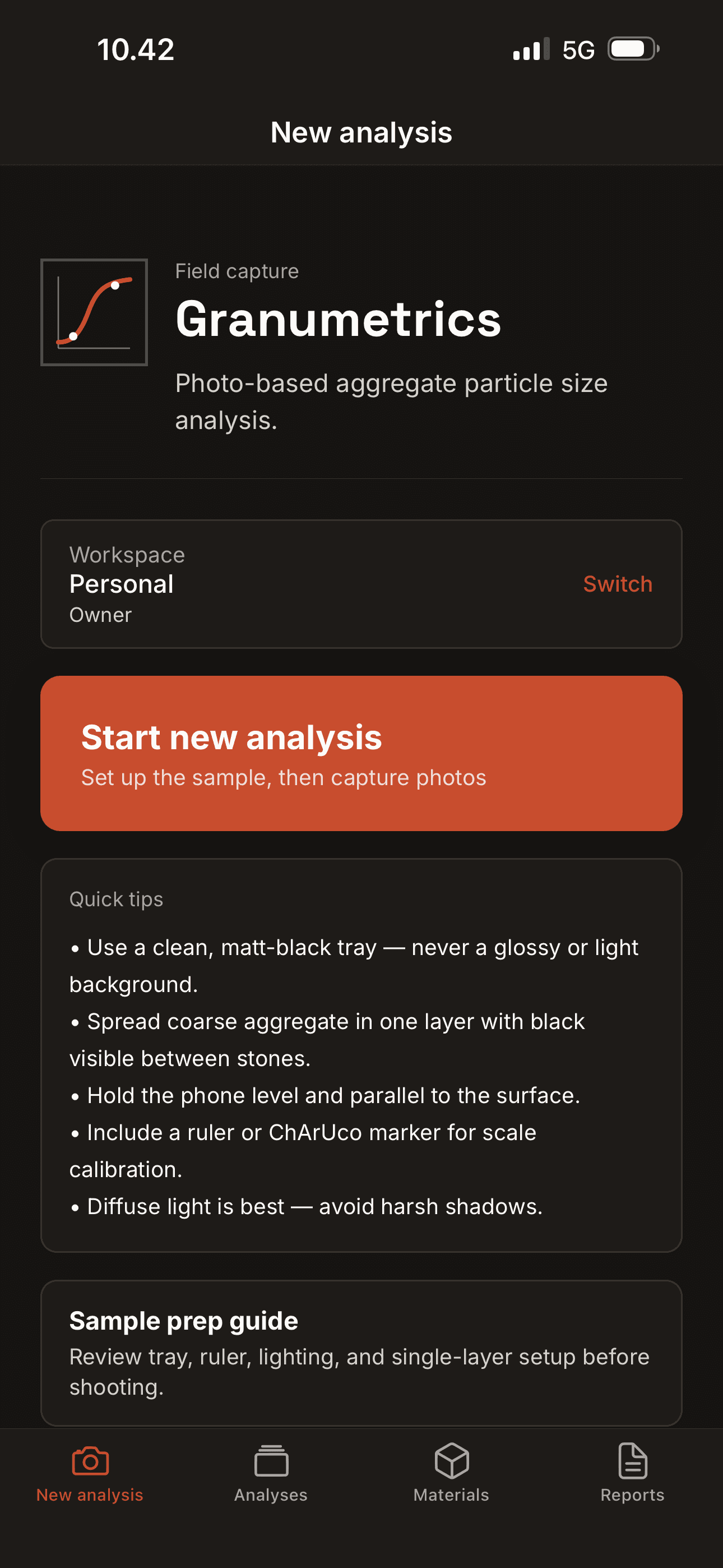
Pick the material, name the analysis, choose how many photos. Ruler or printed ChArUco board for scale.

Material set
CST-0416 · 2 650 kg/m³
02Method+3 s

Camera, or gallery.

Capture new photos in the field, or analyse existing photos from the camera roll. Same processing either way.

Two ways in
Capture or re-analyse
03Capture+11 s

Five photos, held level.

Hold the phone over the sample. Grid, exposure lock, level indicator. Tap, reframe, tap. Five photos in about ten seconds.

Per photo
~1 s · 48 MP
04Calibrate+9 s

Set the scale.

Tap the ruler ends, type the known length. Every pixel is now millimetres; D-values come out dimensional.

Pixels → mm
0.054 mm / px
05Analyse+4 s

Runs in the background.

Each particle is detected, sized, and checked against the standard’s tolerance band. Runs in the background while you set up the next batch.

Throughput
~3 000 particles · 4 s
06Result+1 s · done

The curve.

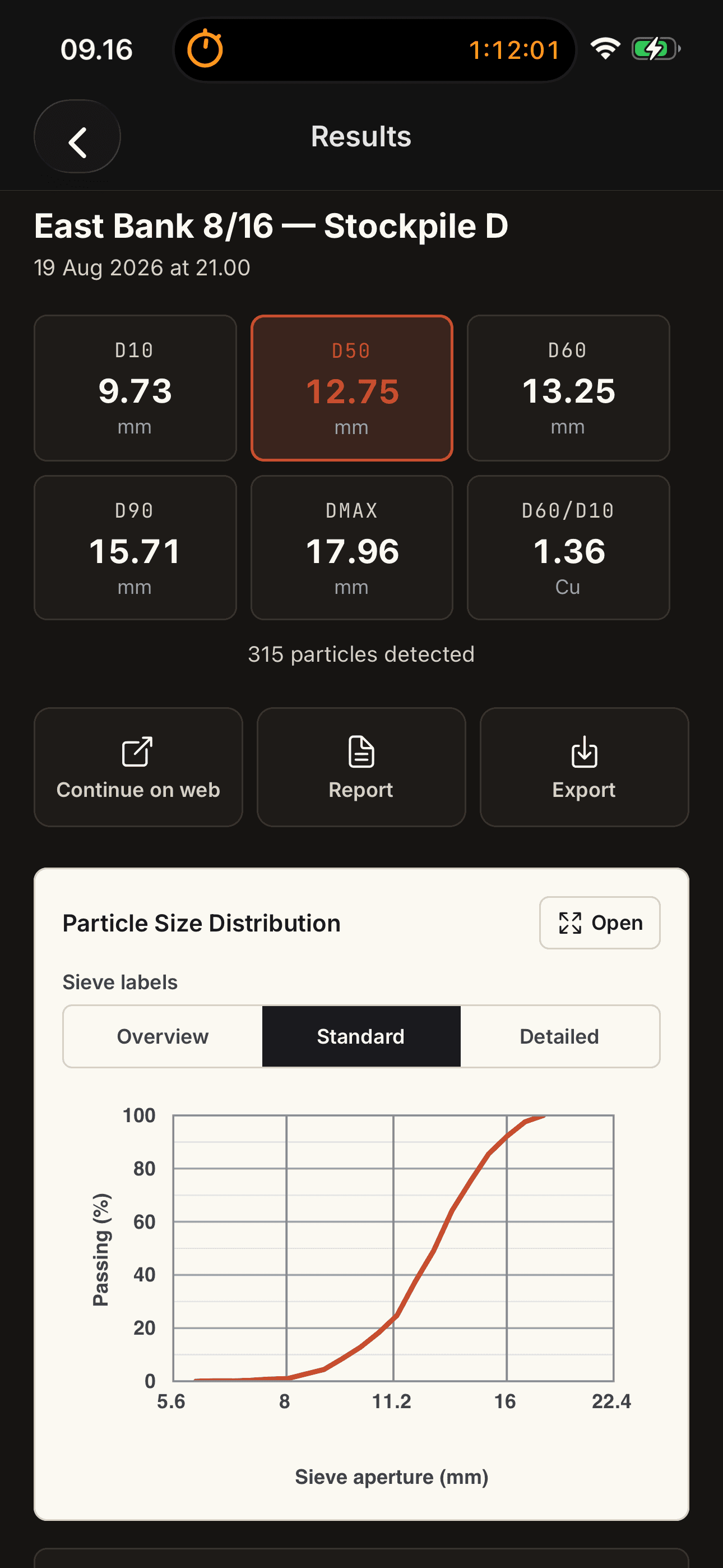
D10, D50, D90 and the PSD curve appear on the phone. Tap Continue on web to review and export.

Total time
~10 seconds · from photo to curve
04
Evidence

What the software saw.

879 particles. Each one measured.

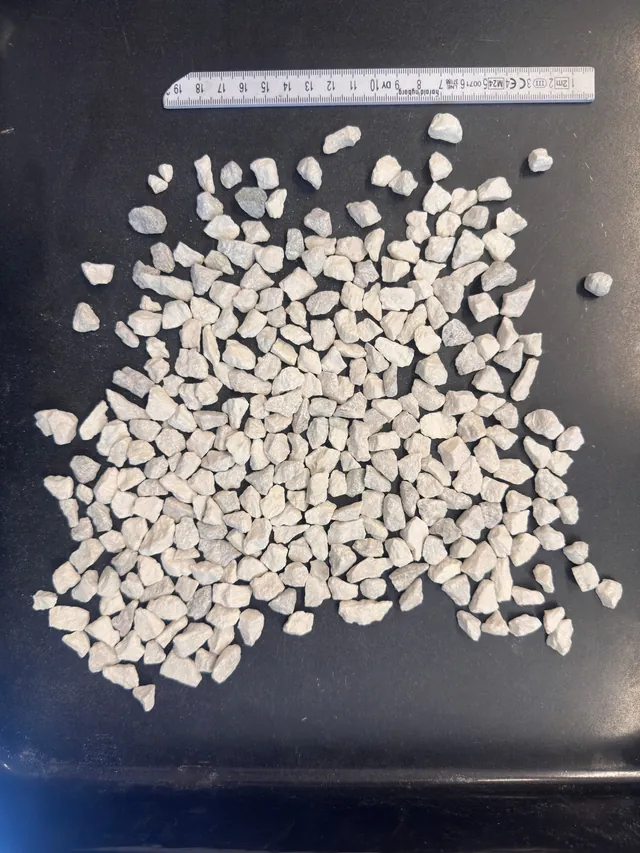
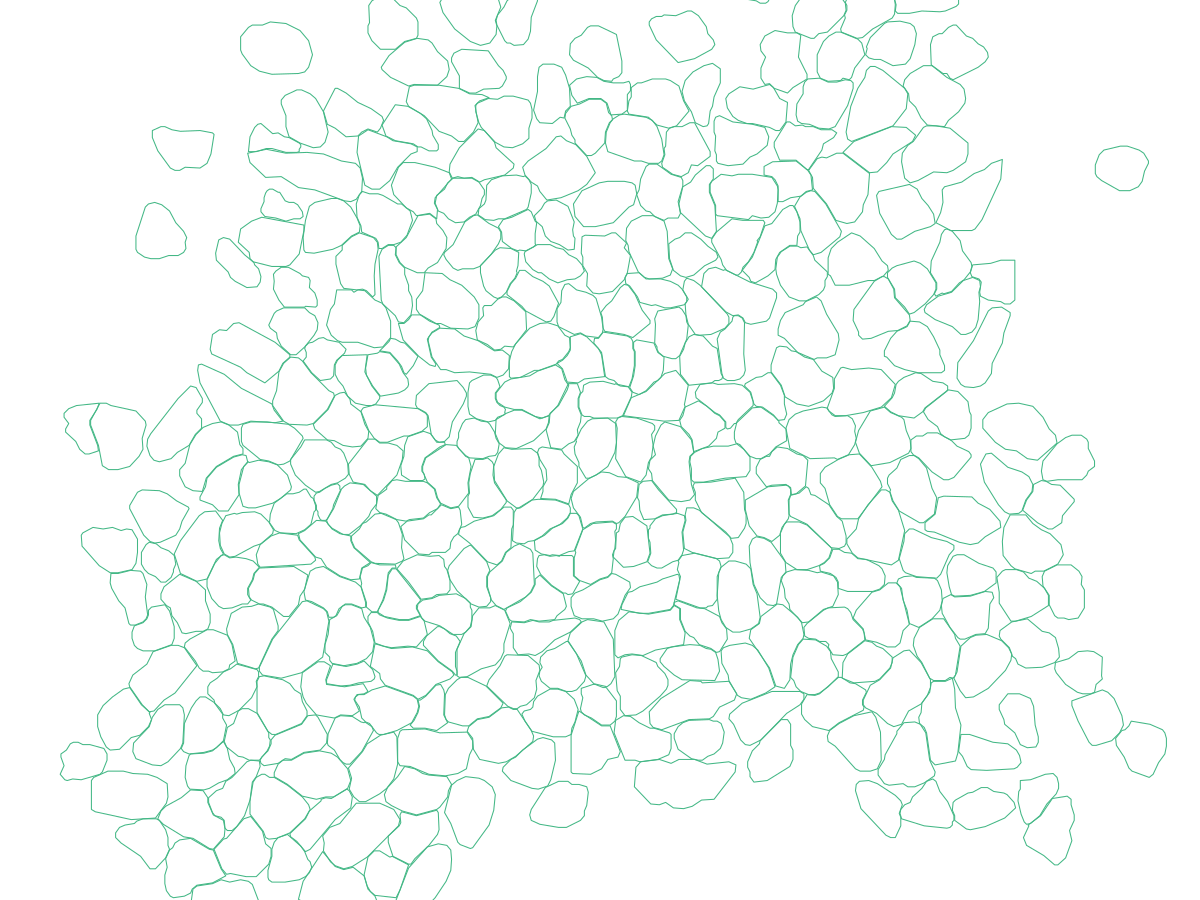
Detected boundariesGhvid 4–8 mm white granite on a black tray, with green outlines drawn around each detected particle and a yellow folding ruler at the top for scale calibration.
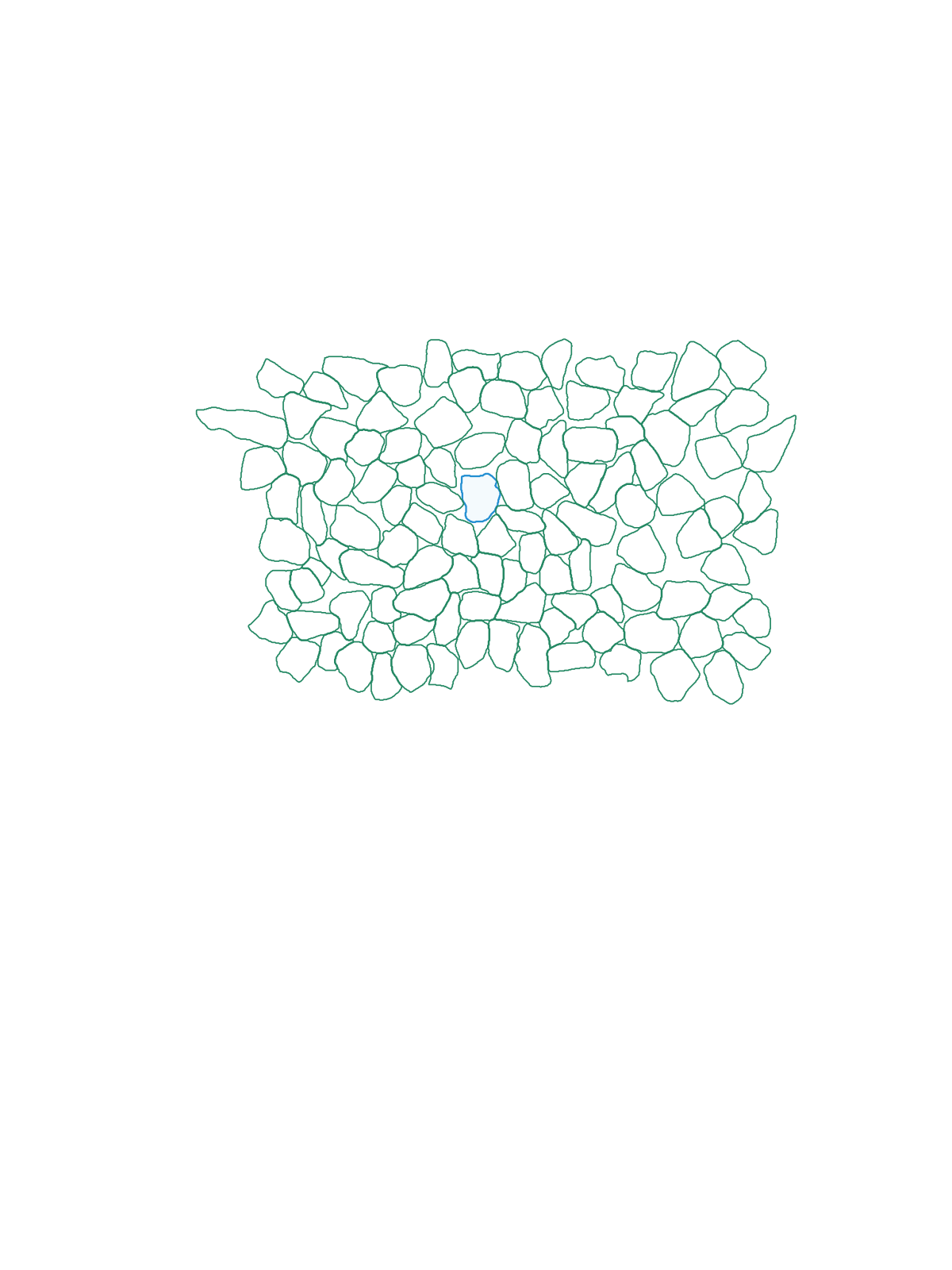
Detail · 566 particlesDensely-packed detail crop of the same Ghvid sample showing individual particle boundaries.
MaterialGhvid 4–8 mm · Danish white granite
Frame 1 · particles313 · full frame
Frame 2 · particles566 · detail crop
Scale calibrationRuler · 0.054 mm/px
05
Compared

Methods
compared.

How the four approaches stack up.

05 · ComparedApply ↗
Sieve testLab reference
Image analysisLab camera system
Laser diffractionFines instrument
GranumetricsPhone app
Time per analysis
25–60 min + drying
~5 min
~5 min (incl. dispersion)
PSD in seconds after capture
Capital cost
$5–20K (sieves + shaker + oven)
$60–90K new · ~$30K used
$40–80K (Malvern, Beckman, Horiba)
No dedicated lab hardware
Per-test cost
Lab labour
Maintenance + filters
Dispersion solvents + maintenance
Included in plan; no per-test fee
Where it runs
Lab only
Lab only
Lab only
Field or lab
Operator
Trained lab tech
Trained lab tech
Trained lab tech
Field crew after short training
Output basis
EN 933-1 reference method
ISO 13322-2; sieve-correlated output
ISO 13320; not EN 933-1
EN 933-1 sieve-grid output; validated vs sieve
PSD range
0.063–125 mm sieve set; EN 933-1 scope to D=90 mm
~20 µm – 30 mm (lab-bench)
~10 nm – 3.5 mm (fines only)
2 mm and up · no upper limit
Time per analysis
Sieve testLab reference

25–60 min + drying

Image analysisLab camera system

~5 min

Laser diffractionFines instrument

~5 min (incl. dispersion)

GranumetricsPhone app

PSD in seconds after capture

Capital cost
Sieve testLab reference

$5–20K (sieves + shaker + oven)

Image analysisLab camera system

$60–90K new · ~$30K used

Laser diffractionFines instrument

$40–80K (Malvern, Beckman, Horiba)

GranumetricsPhone app

No dedicated lab hardware

Per-test cost
Sieve testLab reference

Lab labour

Image analysisLab camera system

Maintenance + filters

Laser diffractionFines instrument

Dispersion solvents + maintenance

GranumetricsPhone app

Included in plan; no per-test fee

Where it runs
Sieve testLab reference

Lab only

Image analysisLab camera system

Lab only

Laser diffractionFines instrument

Lab only

GranumetricsPhone app

Field or lab

Operator
Sieve testLab reference

Trained lab tech

Image analysisLab camera system

Trained lab tech

Laser diffractionFines instrument

Trained lab tech

GranumetricsPhone app

Field crew after short training

Output basis
Sieve testLab reference

EN 933-1 reference method

Image analysisLab camera system

ISO 13322-2; sieve-correlated output

Laser diffractionFines instrument

ISO 13320; not EN 933-1

GranumetricsPhone app

EN 933-1 sieve-grid output; validated vs sieve

PSD range
Sieve testLab reference

0.063–125 mm sieve set; EN 933-1 scope to D=90 mm

Image analysisLab camera system

~20 µm – 30 mm (lab-bench)

Laser diffractionFines instrument

~10 nm – 3.5 mm (fines only)

GranumetricsPhone app

2 mm and up · no upper limit

06
Pilot

Validation underway
with Danish quarries.

Methodology shared on request
Phase II
±3.4 pp

Mean absolute error against the mechanical sieve. Granumetrics runs on the exact material the sieve runs on. We publish the full set, including the worst cases.

Status
In pilot

Pilot projects underway. Methodology and interim correlation data on request. get in touch to run a paired test on your own material.

Run your first
analysis.

Apply for the pilotSee pricing

No credit card · Founder reviews every application